

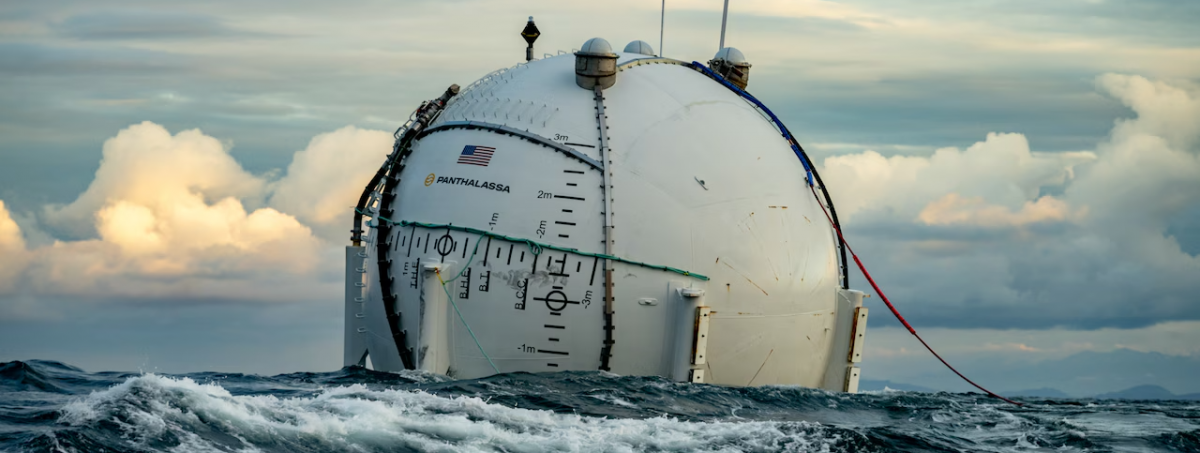
US renewable energy and ocean technology company Panthalassa has raised US$140 million (approximately €129 million) in a Series B financing round to develop autonomous floating nodes that generate electricity from ocean waves and use that power to run AI inference computing at sea. The round was led by Peter Thiel, with participation from John Doerr, Marc Benioff's TIME Ventures, Max Levchin's SciFi Ventures, Hanwha Asset Management's venture fund, Fortescue Ventures, Super Micro Computer, and a range of other institutional and individual investors.
Oregon Live reported that the funding will complete Panthalassa's pilot manufacturing facility near Portland, Oregon, and accelerate deployment of its Ocean-3 series of nodes in the northern Pacific Ocean in 2026, ahead of targeted commercial rollouts in 2027.
Garth Sheldon-Coulson, co-founder and chief executive of Panthalassa, said there are three sources of energy on the planet with tens of terawatts of new capacity potential: solar, nuclear, and the open ocean, and that the company has built a technology platform that operates in the planet's most energy-dense wave regions, far from shore, and turns that resource into reliable, clean power.
Peter Thiel said the future demands more compute than can currently be imagined, while investor John Doerr described the plan as a triple win for workers, communities, and the United States.
Panthalassa's self-propelled nodes capture wave energy to generate electricity and run onboard AI computing, with data transmitted via low-Earth-orbit satellites. The platform is designed to relieve pressure on terrestrial grid infrastructure by expanding energy and computing capacity offshore, avoiding land-based constraints including grid congestion, cooling water scarcity, and permitting delays that increasingly affect conventional data centre development.
Follow the full details on Panthalassa's US$140 million Series B raise.






.png)

