

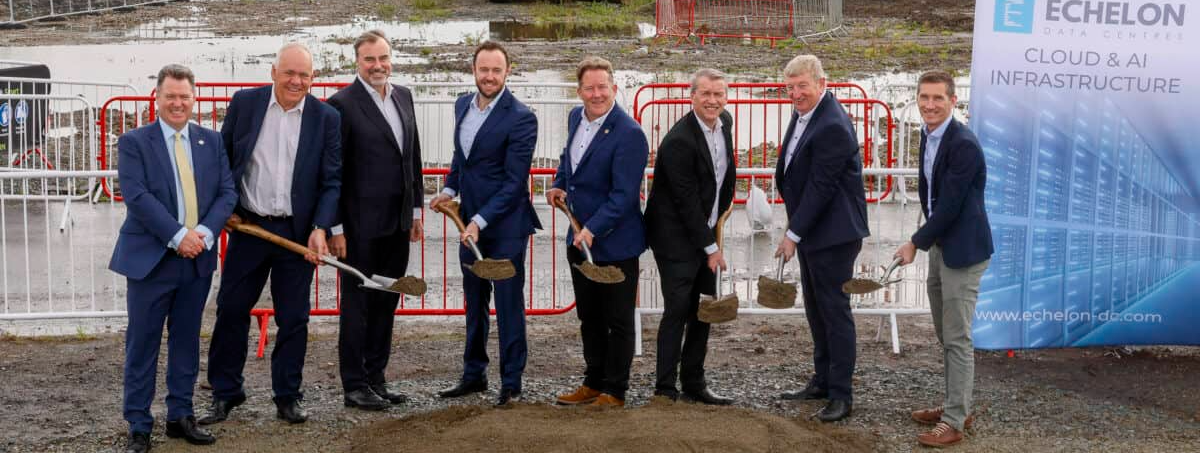
Echelon Data Centres is establishing Ireland’s first Green Energy Park at its DUB20 campus in Arklow, County Wicklow, a model that matters to energy developers, grid operators and large energy users because it co-locates data centre demand with offshore wind, onsite solar and battery storage under the Government’s Large Energy Users Action Plan. The campus, scheduled for completion by 2028, will include a shared 220kV substation connecting DUB20 and SSE’s 800MW Arklow Bank Wind Park 2 to the national grid.
Echelon Data Centres is a Dublin-headquartered data centre owner, developer and operator with campuses in Ireland and the UK, and is investing €4.2 billion in its DUB20 and DUB30 campuses in Wicklow.
SSE is a UK-based energy company developing the 800MW Arklow Bank Wind Park 2 offshore wind project, which will connect through the shared substation.
The park will also add onsite solar generation, battery storage and two energy centres, one able to export electricity to the grid when renewable output is low, which Echelon says will be Ireland’s largest grid-supporting asset that is not a dedicated power station.
Graeme McWilliams, chief strategy officer at Echelon, said: “Creating Ireland’s first Green Energy Park at DUB20 demonstrates how large-scale digital infrastructure can be developed responsibly and in lockstep with national climate and energy policy.” Minister Darragh O’Brien, who broke ground at the site, said the project is the kind of forward-planned, sustainable development the Government wants to see delivered under the Large Energy Users Action Plan.
The park lands against rising grid pressure: data centres used 23% of Ireland’s metered electricity in 2025, up from 5% in 2015, with consumption rising 10% in a single year to 7,663GWh.
The project has also grown: Echelon put the Wicklow investment at €3.5 billion when the DUB20 and DUB30 campuses were launched in May 2025, against €4.2 billion now.
DUB20 was the first large-scale Irish data centre in more than four years to receive a grid connection, reflecting compliance with the regulator’s 2021 requirements.
For the sector, a data centre that supplies the grid as well as drawing from it tests whether large energy users can add flexibility rather than only demand.
Source: reNEWS / CSO / Silicon Republic / Data Centre News







.png)

