

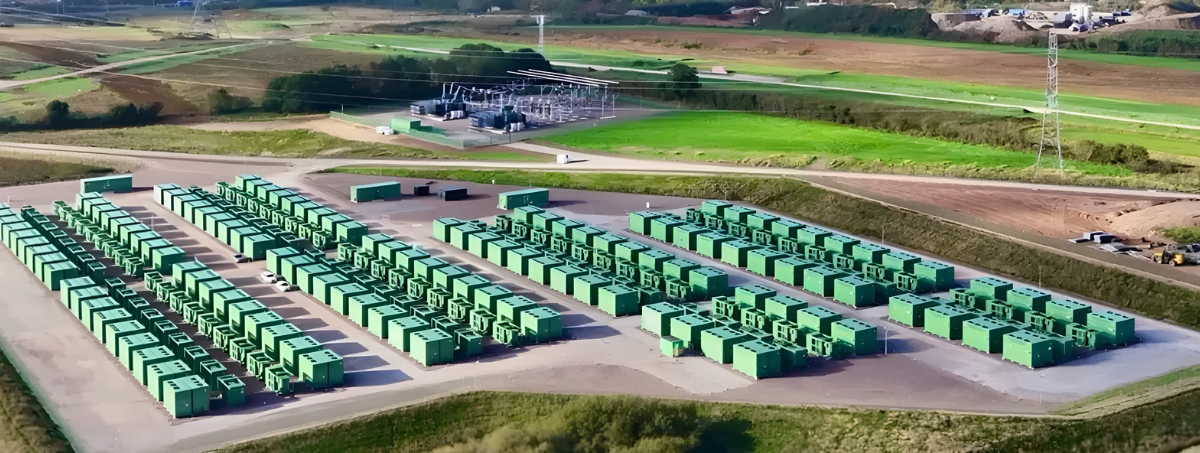
BW ESS has put its 350MW/1,240MWh Hams Hall battery storage project in the West Midlands into commercial operation, the largest in Europe by capacity, according to Energy-Storage.News, a milestone that matters to developers, lenders and grid operators because it shows a battery of this scale moving from energisation to commercial operation in 20 days. BW ESS said in its announcement on 2 November that the first phase is next to National Grid’s Hams Hall substation, with a second phase planned to take the site to 400MW/1,424MWh.
BW ESS is a Zurich-headquartered energy storage owner-operator and part of BW Group, operating a 331MWh battery at Bramley in Hampshire and building 857MWh at Berkswell near Solihull, according to reNEWS.
Sungrow is the Chinese inverter and battery storage manufacturer that supplied 280 PowerTitan 2.0 liquid-cooled units, according to ESS News.
EDF is the French power group optimising the project under a 10-year floor and optimisation agreement, according to reNEWS.
National Grid is the UK electricity transmission company whose Hams Hall substation sits beside the project and which BW ESS named among its commissioning partners.
Solar Power Portal reported that financing from three international banks was secured last month and will close when the project reaches commercial operation.
Erik Strømsø, CEO and co-founder of BW ESS, said in the company’s announcement: “The project was built and commissioned on budget and ahead of schedule, which is a remarkable achievement for a system of this scale and complexity and a testament to the dedication and expertise of our team, and the commitment and collaboration of our partners.”
Energy-Storage.News noted that Bramley, also BW ESS’s, was Europe’s largest when it entered commercial operation in early 2025.
According to Solar Power Portal, the largest battery online in the UK before Hams Hall was a 300MW/600MWh project at Thurrock.
reNEWS reported that the second phase would enable the facility to support around 1.3 million homes for up to 3.5 hours, roughly the households of Greater Manchester.
For the sector, a 20-day gap from energisation to commercial operation on a 1.24GWh asset shows how quickly large batteries can move to revenue once the grid connection and financing are in place.
Source: Energy-Storage.News / Solar Power Portal / ESS News / reNEWS








.png)

