

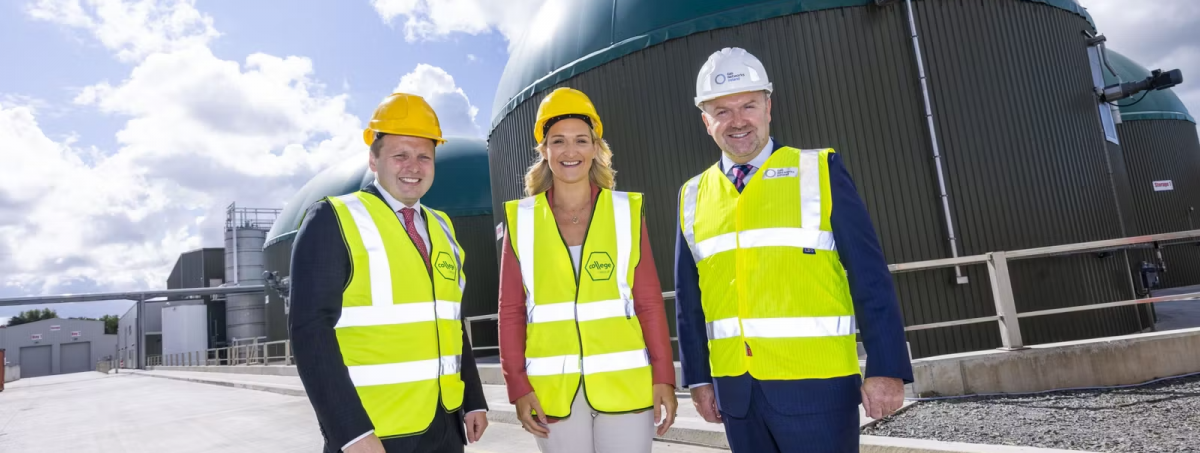
Gas Networks Ireland has connected College Group's new €30 million biomethane facility in Nobber, County Meath, to the national gas network, the second major biomethane producer connected directly to the network this month and a marker of accelerating momentum behind Ireland's indigenous renewable gas sector. The anaerobic digestion plant converts commercial food and agri-food waste into biomethane, powering College Group's own operations and its BioCNG heavy goods vehicle fleet, with capacity to produce up to 75GWh annually.
College Group is a Nobber, County Meath-based bio-waste management company founded in 1989, employing more than 150 people and processing agri-food by-products into biofuels, animal feed and fertiliser through its wider circular economy operations.
Gas Networks Ireland is the state-owned operator of Ireland's national gas network, which has connected two major biomethane producers directly to the network this month alone.
Commercial director John Paul Gilroy said: "Having that gas now connected to the national network is a major achievement for our team and demonstrates what can be achieved through continued investment and innovation." Gas Networks Ireland chief executive David Kelly said the connection sends a strong signal to potential producers and investors that biomethane has a significant place in Ireland's future energy system.
This is the second biomethane connection Gas Networks Ireland has completed within a month, following Bia Energy's Huntstown facility earlier in August, suggesting the network is moving from isolated pilot connections toward a repeatable connection process for the sector.
Even so, the combined output of both facilities remains a small fraction of the roughly 5.7 terawatt-hours the state is targeting from biomethane by 2030, underlining that scaling the sector to target will require dozens more plants of comparable size connecting at a similar or faster pace.
College Group's model, generating fuel for its own heavy vehicle fleet in addition to feeding the grid, illustrates a distinct commercial pathway for biomethane beyond pure grid export: on-site users converting waste streams into transport fuel can capture value twice, through their own fuel cost savings and through excess gas sold to the network.
For the sector, back-to-back connections in the same month suggest Ireland's biomethane pipeline is reaching a point where connection timelines, not just planning or funding, are becoming a repeatable process rather than a bottleneck.
Source: RTE / Meath Chronicle / Agriland




.png)

